
We Are DOOMed
BONUS ARTICLE. How the game of my childhood transitioned from a residually Christian secularised paradigm to a modern neo-pagan, neo-Gnostic cosmology, Satanic soteriology.

I never expected to write essays about video games or fictional universes. It is not really my genre, although games helped me survive my teenage years in a rough neighbourhood of a small Russian town. They were my form of escapism long before I discovered the pleasures of writing pretentiously in a foreign language.
Yet while working on a larger analytical study devoted to St John Paul II, his attitude towards Islam in particular, and towards other religions more generally, I found myself reflecting on the cultural and intellectual environment in which we have all lived over the past few decades: our basic fears and assumptions, the state of culture in matters of religion, the answers offered to the ultimate questions, and even the way those questions are framed.
For some reason, I found myself thinking of the Doom series — perhaps the first video game I ever saw, installed in 1998 on my grandfather’s work computer.
I remembered it. And the memory left me uneasy.
For I realised that Doom is one of those game series that reflects the transformation of the Western imagination itself. Over the course of three decades, it traces a movement away from broadly post-Christian categories towards an increasingly immanent secularism and deism, and from there towards forms of thought that are strikingly reminiscent of ancient Gnosticism (but in fact much darker than it) and a profoundly pagan understanding of the cosmos.
A link to this essay will appear in the appropriate place within the main text on St John Paul II (Pt 1, Pt 2) For now, however, let us examine the evolution of the heroes and villains of a game that has become iconic in every sense of the word.
Stage 1: Christian Substrate Secularised
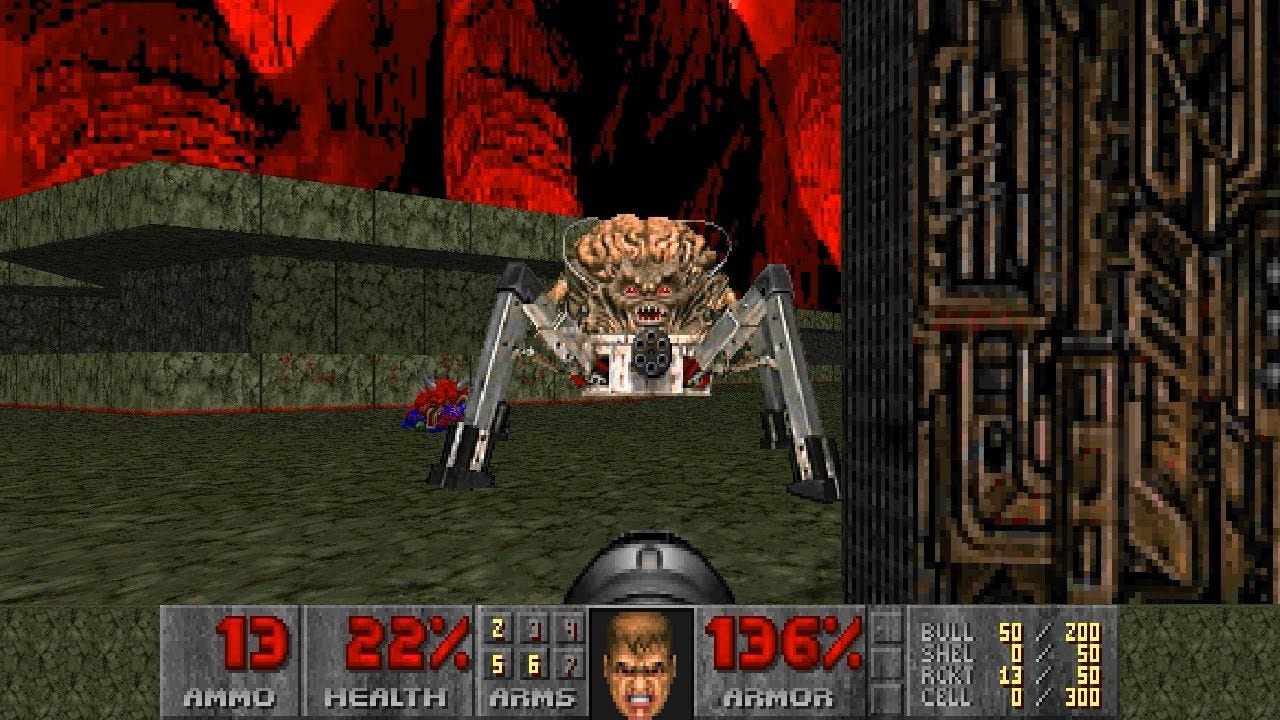
In the end of the original DOOM (1993), the unnamed Doom Guy fought the Spider Mastermind as a final boss, a cybernetic demon combining flesh, technology, and spirit. It commanded Hell’s invasion of the Martian moons and, ultimately, Earth. It is significant that, given to us to fight in flesh and steel, the boss and the villan is spiritual in nature and homicidingly malignant. It is the remeniscence of devil from the Christian perspective.
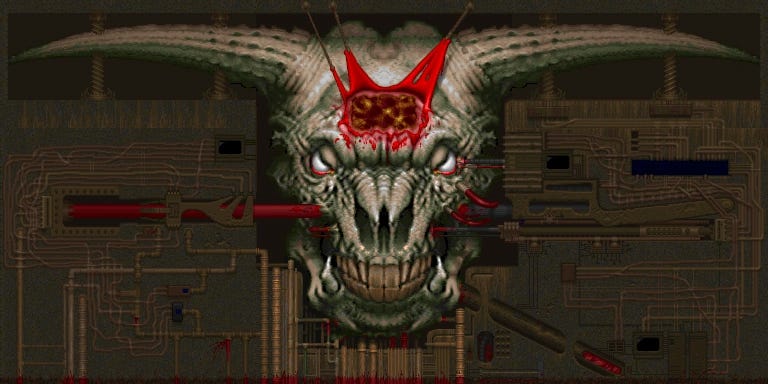
In Doom II (1994), the enemy became the Icon of Sin, a colossal infernal titan directing Hell’s assault on humanity. It looks like a Bathameth and is often referred to as such by the gamers’ community.
In Doom 64 (1997), the final foe was the Mother Demon, responsible for restoring Hell’s armies after their defeat.
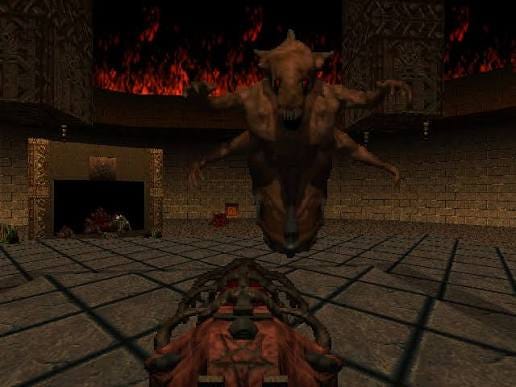
The evil is spiritual in origins, coming ‘from the other side,’ compound in nature, while the threat it imposes is material.
Stage 2: Complete Secularisation of Evil.
A significant shift occurred with Doom 3 (2004). The Cyberdemon remained the final monster, but the true antagonist was Dr Malcolm Betruger, a human scientist who willingly opened the way to Hell. Evil was no longer merely an external force invading humanity; it had found a collaborator within humanity itself. This development continued in DOOM (2016). Its principal antagonist, Olivia Pierce, was a satanist, but her religious fanaticism was in fact very pragmatic, for she wanted to use Hell as… a source of energy to be exploited! Evil was increasingly presented as a technological solution pursued without moral limits.
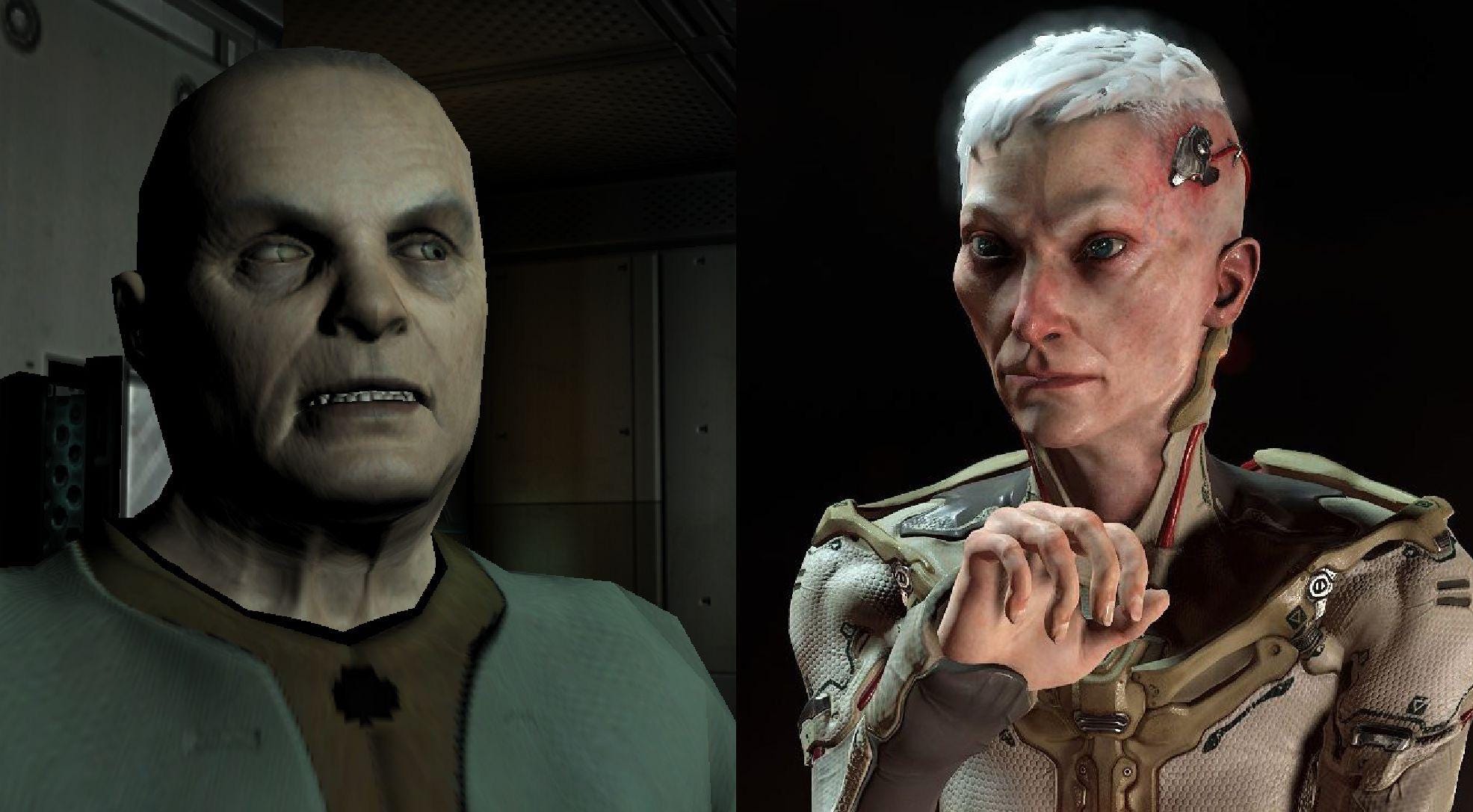
So, the threat is in the science, the corporations, in human malignancy, no longer in demons per se. No longer the supernatural Icon of Sin, but the technofascist Mask of Musk.
The villan is still compound in nature, but now the spiritual component is fully immanent — it is in the realm of ideas within a human mind.
Stage 3: the Gnostic Re-Enchantment
The new series of the game experienced a narrative break that called into question all the motivations, ethos, pathos, and logos of the previous parts.
With Doom Eternal (2020), the series entered the realm of a different, non-Christian cosmic theology. The Khan Maykr, initially presented as an angelic ruler, is revealed to sustain her pretty material civilisation through the sacrifice of entire worlds. Heaven and Hell cease to function as clear moral opposites and become parts of the same cosmic system, just as some sort of rival realms of the cosmos.
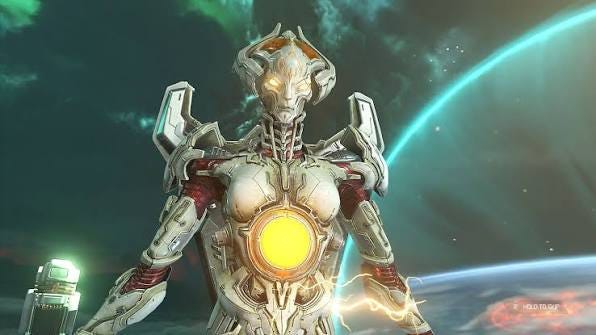
The expansions The Ancient Gods (what a name!) deepen this transformation through the figures of ‘the Father’ and the Dark Lord, Davoth.
The Father is the demiurge who initially appears to occupy the role of God, yet he is ultimately revealed to be one actor within a larger cosmic conflict. Davoth, ruler of Hell, claims to be the original creator who was overthrown by his own creation.
Well… In this respect, the later DOOM mythology resembles certain forms of Gnosticism much more than Christianity. Historically, there were sects of Ophites and Cainites who worshiped the biblical ‘bad guys,’ believing that the history of the Old Testament was written incorrectly, from the position of an evil demiurge and usurper. But I would insist it is not that simple, for the Gnostics of old were at least moral objectivist and dualist, knowledge-oriented and humble in too many ways we, the contemporary people, are not.
Are We Back to Gnosticism?
At first glance, all the familiar elements seem to be present, especially in matters concerning the vanishing border between transcendence and immanence, the creation of the world, the role of the demiurge, and similar themes. Yet there are important differences that make our contemporary form of Gnosticism distinct from its ancient counterpart, and in a way — much darker.
For the classical Gnostics, the creation of the world was understood as the work of lower beings, powers of limited knowledge and ability that either did not know the true God or had rebelled against Him. In some systems, creation itself was seen as a violation of the original order, brought about through the actions of demiurgic powers and the emergence of a primordial being born of their rebellion. Salvation, therefore, could ultimately be achieved only through liberation from the material world and, in some accounts, through its final destruction.
The interests of the classical Gnostics were not centred upon cosmology for its own sake. Their primary concern was always God and the predicament of man. The story of the world’s origin mattered because it explained humanity’s desparate condition. Knowledge of the world’s formation and nature was valuable only insofar as it enabled the Gnostic to overcome the world, to leave it, to go beyond. Having come to know the true God and the heavenly realm, the Gnostic recognised the insignificance of material existence and sought separation from it in order to return to the divine source.
Our modern ‘Gnostics,’ however, seem to desire precisely the opposite. They do not seek the destruction of the material world, nor escape from it. Rather, they seek its preservation and perpetual improvement of it on secular, worldly foundations.
The emotional energy of the newer DOOM games is directed towards the endless defence and maintenance of the world, not towards the liberation of the spirit or reunion with a transcendent source. There is nowhere to go beyond, for there is no beyond anymore, as we have established looking at the new parts of Doom:
The highest authority is no longer clearly identified with the creator of the world, but the both become morally ambiguous — not simply bad or good. Heaven and Hell are transformed from realms of good and evil into competing factions within a larger conflict that is pragmatic and political rather than metaphisical in nature.
DOOM: The Dark Ages continues this trend through Prince Ahzrak, a demonic ruler who presents Hell not as a place of punishment but as an organised civilisation with its own hierarchy, politics, and imperial ambitions. Doom Slayer fights him and defeats him in the same way that the sworn enemies of the early feudal times, the kings of the early Middle Ages, those very same Dark Ages, defeated each other...
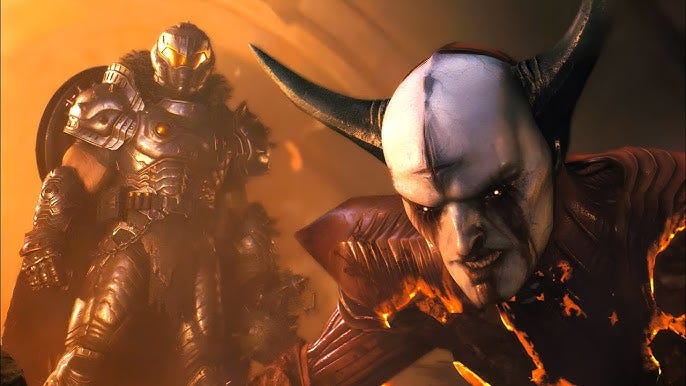
At this stage, the composite nature of the villain disappears. The original lore is lost, the initial intentions of an old-days Doom Guy from the 1990s and 2000s — forgotten.
The other world becomes fully explored and, in a sense, this-worldly: accessible, intelligible, and open to investigation and manipulation. Its inhabitants no longer possess a fundamentally different mode of existence. Phenomenologically, their nature differs little from that of the protagonist — and, by extension, from that of the player.
They are no longer transcendent powers represented through a strange union of a stanger spirit and magical biomechanical forms. Instead, they become ordinary beings, in all their complexity, operating according to the same internal logic as the rest of the game’s universe. They inhabit another realm, but not another order of reality.
The supernatural has been fully domesticated, integrated and dissolved. This significantly distinguishes the world of the later parts of Doom from classical Gnostic paradigms, despite all the similarities in other elements.
There is a Yaldabaoth-like figure in the form of ‘the Father’ and the Khan Maykr in the game, a false ruler who presents herself as a heavenly authority. A few of them, in fact… to be dethroned. There are countless aeons in the form of angels, demons, and cosmic powers… to be slaughtered. There is a primordial disruption of harmony and a struggle among rival supernatural beings… to be mastered. Gnostics would never be bold to claim the three attributes marked above. Also, one traditional Gnostic element appears to be missing: the Highest Being, the true God. Or perhaps it is not missing at all.
For there is, in fact, a supreme principle standing above the entire cosmic drama. It is neither the Father nor the Dark Lord. It is the protagonist himself. It is Doomguy. And behind Doomguy stands the player.
Cult of the Self
In the original games, Doomguy is simply a human marine: courageous, stubborn, and exceptionally effective, but nevertheless human.
In Doom II, he becomes the defender of Earth, and in Doom 64 a voluntary exile who chooses to remain in Hell in order to contain its forces. It is a Christ-like figure, a hero.
By the time of DOOM (2016), however, he has become the Doom Slayer, a legendary figure feared by demons themselves. In Doom Eternal, it is revealed that he is the same Doomguy from the earlier games, having passed through centuries of warfare and been transformed by supernatural powers. No longer merely a soldier, he becomes a mythic champion standing between worlds.
The process reaches its conclusion in The Ancient Gods (still, what a speaking name!). The Slayer no longer fights demons alone; he confronts cosmic rulers, kills gods, defeats the Dark Lord himself, and determines the fate of creation. His role has shifted from that of a man resisting evil to that of a quasi-divine hero participating in the struggles of primordial powers.
This development mirrors the wider evolution of the series. The early games present a recognisably Christian structure, although trapped in the immanent, the material, the palpable — in which an ordinary man confronts evil invading from outside creation. Yet he does it alone, with no God’s assistence.
The later games increasingly resemble pagan epic and mythological cosmology. Precisely because no God’s help has been needed before. The protagonist is no longer a man resisting supernatural forces, but a heroic figure akin to Hercules, Achilles, or maybe Gilgamesh… But rather a Cratos from another game series: a slayer of monsters, kings, and gods alike.
The ancient Gnostic sought salvation through knowledge. The modern Gnostic seeks it through agency. The highest power is no longer the hidden God beyond the cosmos, but the sovereign self confronting and reshaping the cosmos according to its own will. The universe exists neither for contemplation or redemption (as classical pagan philosophers or Christians would claim), nor for destruction (as Gnostics did insist). It exists to be mastered. The ultimate transcendence is no longer above the world, but within self.
This is why we do not live in a world where Gnosticism or paganism has simply returned victorious.
The post-Christian world is not a restored version of the pre-Christian one. It is something darker. Once a culture has encountered Christ, and through Him learned to recognise the ontological dignity of both the world and the human person, it cannot simply return to where it began. The memory of Christianity remains even after faith has been abandoned.
If such a culture renounces God, it does not revert to paganism. Rather, it becomes satanic in the theological sense: created, yet denying its dependence upon its Creator; rebellious against the source of its own existence; determined to shape the destiny of the world by its own will and to attain immortality on its own terms.
The rebellion of the modern world is therefore not the innocence of those who never knew Christ. It is the revolt of a civilisation that inherited a Christian understanding of human significance while rejecting the God from whom that significance was received.
To our cilivisation says Ezekiel:
28 The word of the Lord came again unto me, saying,
2 Son of man, say unto the prince of Tyrus, Thus saith the Lord God; Because thine heart is lifted up, and thou hast said, I am a God, I sit in the seat of God, in the midst of the seas; yet thou art a man, and not God, though thou set thine heart as the heart of God:
3 Behold, thou art wiser than Daniel; there is no secret that they can hide from thee:
4 With thy wisdom and with thine understanding thou hast gotten thee riches, and hast gotten gold and silver into thy treasures:
5 By thy great wisdom and by thy traffick hast thou increased thy riches, and thine heart is lifted up because of thy riches:
6 Therefore thus saith the Lord God; Because thou hast set thine heart as the heart of God;
7 Behold, therefore I will bring strangers upon thee, the terrible of the nations: and they shall draw their swords against the beauty of thy wisdom, and they shall defile thy brightness.
8 They shall bring thee down to the pit, and thou shalt die the deaths of them that are slain in the midst of the seas.
9 Wilt thou yet say before him that slayeth thee, I am God? but thou shalt be a man, and no God, in the hand of him that slayeth thee.
10 Thou shalt die the deaths of the uncircumcised by the hand of strangers: for I have spoken it, saith the Lord God.
One may argue, this is what is happening.
The good news is that, just as it is impossible to return to a humble Gnosticism or a gods-fearing paganism once one has become Christian, as one can only become satanic by rebelling against God and the created order on the basis of a self-conscious individuality and dignity elevated into an absolute, so too the cure for this condition is not a simple ‘return to Christianity’ in some revisionist form.
Rather, it is a movement forward towards Christ and His Church, towards the proper balance between will and humility. A culture that has encountered Christ cannot undo that encounter or the rejection of it. But before the Second Coming of our Lord the path is open to a new encounter, a new acceptence, a new chance to feast on what has been bestowed to us of old by the Holy Trinity.
This search is visible in every sphere of human activity, including the world of video games. But that is a discussion for another time.
Hazbin Hotel is basically the endpoint this trajectory in musical format, but with the understanding of international relations, law, and morality one would expect from a Disney adult.
At this point I'm not sure if described changes are a product of a changing cultural landscape or simply the need to market new enemies, new stories, new concepts for new products in what's essentially a content empty aesthetic.
Christian cosmology does not lend itself to video game or fantasy easily. All the examples of great Catholic fantastical fiction have Christianity as a broad backdrop for a world in which in it is not directly apparent. With Tolkien we had gods and angels and fallen angels, but God doesn't play a direct part. In The Book of the New Sun God is orchestrating small events that feed into a great redemptive catastrophy, while in something new like Sun Eater God is, again, very much in the background.
What we believe does not make for a good "setting” in the way Gnostic mythology or various pagan religions do.
When Christianity is used as direct inspiration, but emptied of its actual theological content, we get progressive slop like Between Two Fires.
With these I think that Doom is just trying to retell the same story over and over again, because it's expected by the market to have a story.